
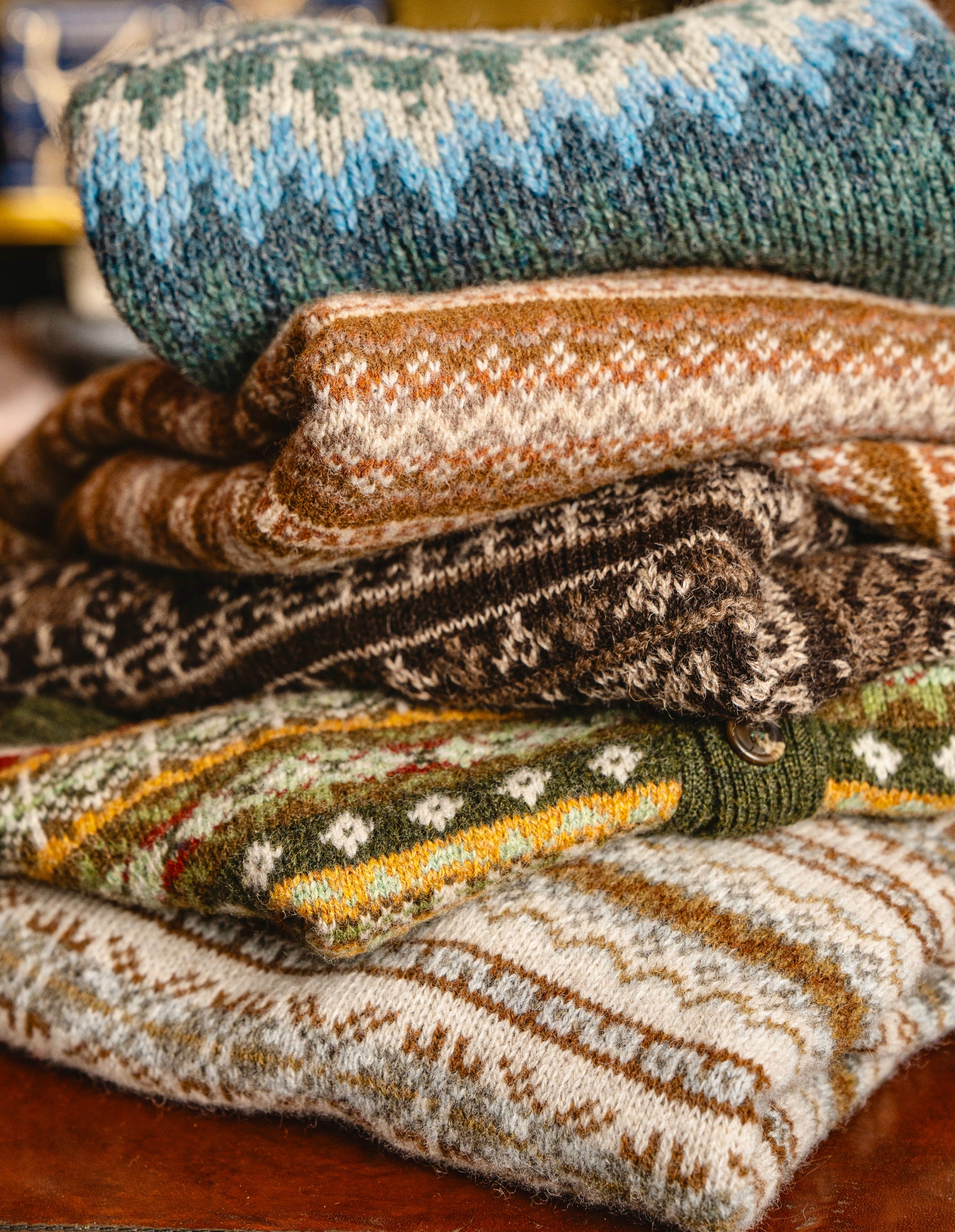
 Fair Isle sweaters are produced using Fair Isle knitting, a traditional stranded colorwork technique originating from the remote Fair Isle in Scotland. It’s defined by its small, repeating geometric patterns, limited color palettes (typically 2–5 colors per row), and the way unused yarns are carried behind the work (not cut) to create intricate designs without bulky floats. Here’s a detailed breakdown of the core techniques and steps:
1. Core Technique: Stranded Colorwork (Jardinière Knitting)
The defining feature of Fair Isle production is stranded knitting, where two or more yarn colors are used in a single row to form patterns. Key rules of the technique:
No cutting yarn between colors: Unused yarns are carried (floated) loosely behind the knit fabric as you work with the active color. Short floats (1–5 stitches max) are critical to keep the fabric lightweight and flexible—long floats would catch on objects and create bulk.
Limited colors per row: Traditional Fair Isle uses only 2 colors per row (a main color + a pattern color) to avoid tangled floats. Modern variations may use up to 5, but the principle of short, controlled floats remains.
Small, repeating motifs: Patterns are tiny (e.g., diamonds, crosses, stars, zigzags) and repeat across the garment. This simplicity ensures the floats stay short and the fabric remains wearable.
2. Tools Used in Production
Circular knitting needles or flat needles: Traditional hand-knitters use circular needles for seamless sweaters; machine production uses industrial circular knitting machines (common for mass-market Fair Isle styles).
Yarn bobbins or balls: Each color is wound onto a separate bobbin to prevent tangling while switching between strands.
Tension tools: For consistent stitch size (critical for even patterns)—hand-knitters use tension rings, while machines have built-in tension controls.
3. Step-by-Step Production Process (Hand-Knit Example)
Cast on the main body stitches: Start with the main base color (e.g., cream or navy) to set the sweater’s size and shape (body, sleeves, yoke).
Introduce pattern colors: For each row, alternate between the base color and pattern colors to create the repeating motif. For example:
· Row 1: Knit 3 stitches of color A (base), 2 stitches of color B (pattern), repeat across the row.
· Carry color B loosely behind the 3 stitches of color A, and vice versa.
Control float length: If a color isn’t used for more than 5 stitches, catch the floating yarn (trap it) with a small stitch to avoid long, loose strands (this is called "catching floats").
Work the yoke (signature Fair Isle feature): Most Fair Isle sweaters have a patterned yoke (the shoulder/neck area) with a solid body and sleeves. The yoke is often the focal point, with the most intricate patterns.
Shape the garment: Add decreases/increases for armholes, necklines, and sleeve cuffs—all while maintaining the pattern consistency.
Finish the edges: Sew seams (if using flat needles), add ribbed cuffs/hem (usually in a solid color to contrast the pattern), and attach a collar (often a simple rib or crew neck).
4. Machine Production Adaptations
For commercial Fair Isle sweaters, industrial computerized circular knitting machines are used:
· The pattern is programmed into the machine, which automatically switches between yarn colors and controls float length.
· Machines can produce consistent, uniform patterns at scale, while still adhering to the core stranded colorwork rules (short floats, limited colors per row).
· The result is a garment that retains the traditional Fair Isle aesthetic but is faster to produce than hand-knit versions.
5. Traditional Rules & Aesthetic Principles
Fair Isle knitting has strict traditional guidelines that define its authenticity:
Small motifs only: No large, single designs—patterns must repeat across the fabric.
Muted, natural color palettes: Traditional colors are derived from natural dyes (indigo, moss green, heather purple, cream) to reflect the island’s landscape.
Lightweight fabric: The technique prioritizes wearability—Fair Isle sweaters are meant to be warm but not bulky, suitable for Scotland’s temperate maritime climate.